Made in USA
Healing
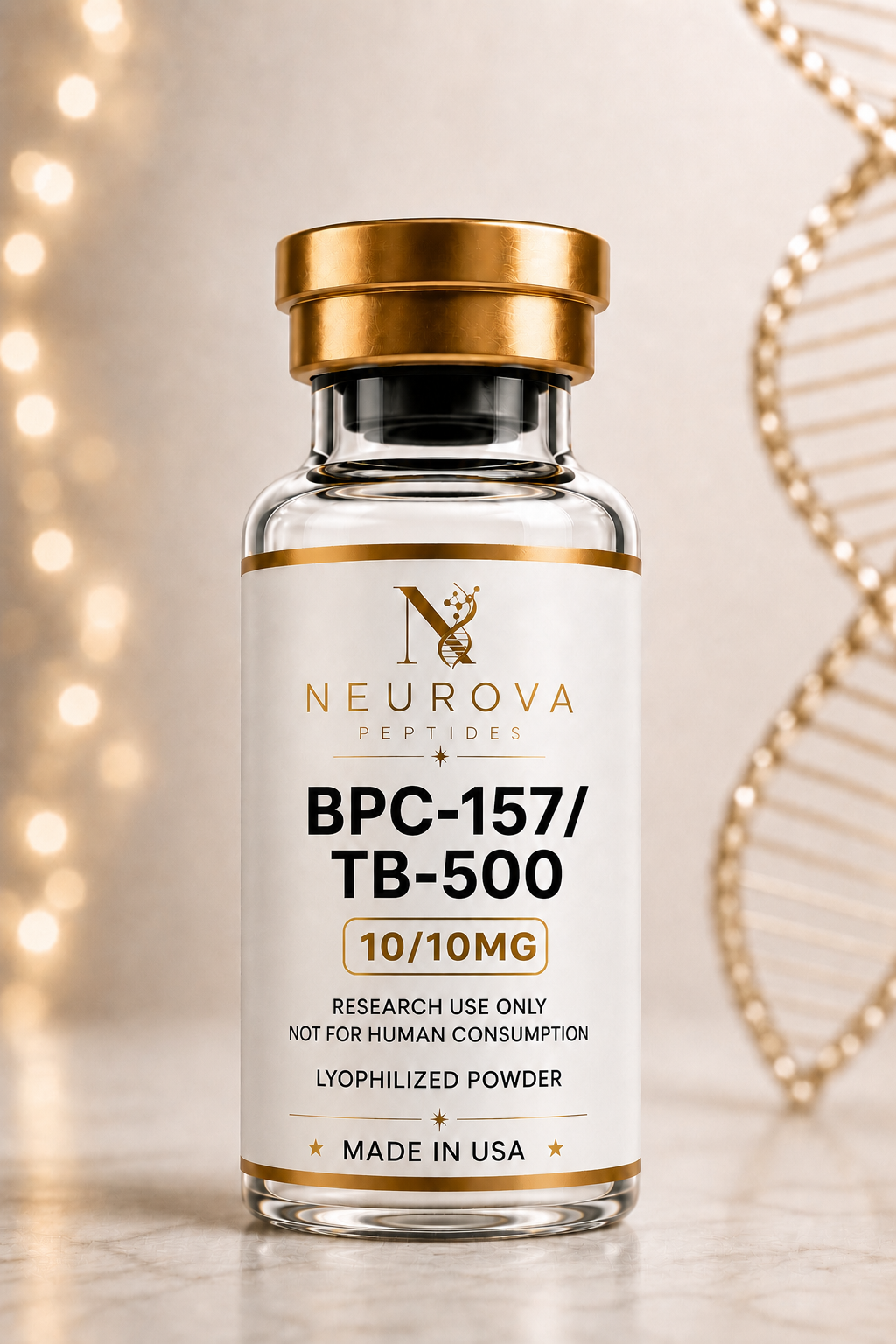
BPC-157 / TB-500 Blend
Made in USA · Research Use Only
Premium research-grade BPC-157 / TB-500 Blend · Made in USA
$140
Select Strength
Dosage
10mg
Packaging
1 vial
Purity
HPLC ≥ 98%
Origin
USA
For research use only. Not for human consumption. Products are intended for laboratory research by qualified professionals.
BPC-157 / TB-500 Blend
BPC-157 / TB-500 Blend combines two investigational peptides that are widely studied for their potential to support tissue repair, recovery, and regenerative processes. BPC-157 and TB-500 have different but potentially complementary mechanisms, making this one of the most commonly researched peptide combinations for musculoskeletal recovery. However, there are no controlled human clinical trials demonstrating that the blend itself is safe or effective, and both peptides remain investigational.
Potential Benefits
Muscle & Soft Tissue Recovery
* Supports muscle recovery
* May promote tendon healing
* Supports ligament repair
* Helps maintain connective tissue health
Joint & Connective Tissue Health
* Supports joint mobility
* Promotes collagen production and tissue remodeling
* May support cartilage health
* Helps maintain flexibility
Tissue Repair
* Supports wound healing
* Promotes healthy angiogenesis (formation of new blood vessels)
* Supports cellular regeneration
* May accelerate recovery following tissue injury
Anti-Inflammatory Support
* Helps regulate inflammatory responses
* Supports recovery after intense physical activity
* May reduce localized inflammation
* Promotes healthy healing processes
Recovery & Performance
* Supports return to activity after injury
* Helps maintain healthy muscle function
* May improve recovery capacity
* Complements rehabilitation programs
Mechanism of Action
BPC-157
* Supports angiogenesis and blood vessel formation
* Promotes fibroblast activity and collagen synthesis
* Modulates nitric oxide signaling
* Supports gastrointestinal and connective tissue integrity
TB-500
* Derived from Thymosin Beta-4
* Supports cell migration and tissue remodeling
* Helps regulate actin dynamics involved in cellular repair
* Promotes regeneration across multiple tissue types
Together, these peptides are being investigated for their complementary roles in tissue healing and recovery, although the combination has not been validated in controlled human trials.
Suggested Administration
The blend is generally administered by subcutaneous (SC) injection in research settings. There is no FDA-approved dosing regimen for general clinical use.
Storage
* Store lyophilized peptide refrigerated (2–8°C / 36–46°F)
* After reconstitution, refrigerate
* Protect from light
* Avoid repeated freeze-thaw cycles
Possible Side Effects
Human safety data remain limited. Potential side effects include:
* Injection site irritation
* Mild headache
* Nausea
* Temporary fatigue
* Dizziness (uncommon)
Research Areas
* Tendon and ligament injuries
* Muscle recovery
* Joint and cartilage repair
* Wound healing
* Sports medicine
* Tissue regeneration
* Gastrointestinal healing (primarily BPC-157)
Notes
* BPC-157 / TB-500 Blend is an investigational peptide combination and is not FDA-approved for medical treatment in the United States.
* Most evidence comes from animal and laboratory studies, with limited human clinical data for the individual peptides and essentially no controlled human trials evaluating the blend itself.
* While preclinical findings are promising, additional high-quality clinical research is needed to establish its long-term safety and effectiveness.
BPC-157 / TB-500 Blend combines two investigational peptides that are widely studied for their potential to support tissue repair, recovery, and regenerative processes. BPC-157 and TB-500 have different but potentially complementary mechanisms, making this one of the most commonly researched peptide combinations for musculoskeletal recovery. However, there are no controlled human clinical trials demonstrating that the blend itself is safe or effective, and both peptides remain investigational.
Potential Benefits
Muscle & Soft Tissue Recovery
* Supports muscle recovery
* May promote tendon healing
* Supports ligament repair
* Helps maintain connective tissue health
Joint & Connective Tissue Health
* Supports joint mobility
* Promotes collagen production and tissue remodeling
* May support cartilage health
* Helps maintain flexibility
Tissue Repair
* Supports wound healing
* Promotes healthy angiogenesis (formation of new blood vessels)
* Supports cellular regeneration
* May accelerate recovery following tissue injury
Anti-Inflammatory Support
* Helps regulate inflammatory responses
* Supports recovery after intense physical activity
* May reduce localized inflammation
* Promotes healthy healing processes
Recovery & Performance
* Supports return to activity after injury
* Helps maintain healthy muscle function
* May improve recovery capacity
* Complements rehabilitation programs
Mechanism of Action
BPC-157
* Supports angiogenesis and blood vessel formation
* Promotes fibroblast activity and collagen synthesis
* Modulates nitric oxide signaling
* Supports gastrointestinal and connective tissue integrity
TB-500
* Derived from Thymosin Beta-4
* Supports cell migration and tissue remodeling
* Helps regulate actin dynamics involved in cellular repair
* Promotes regeneration across multiple tissue types
Together, these peptides are being investigated for their complementary roles in tissue healing and recovery, although the combination has not been validated in controlled human trials.
Suggested Administration
The blend is generally administered by subcutaneous (SC) injection in research settings. There is no FDA-approved dosing regimen for general clinical use.
Storage
* Store lyophilized peptide refrigerated (2–8°C / 36–46°F)
* After reconstitution, refrigerate
* Protect from light
* Avoid repeated freeze-thaw cycles
Possible Side Effects
Human safety data remain limited. Potential side effects include:
* Injection site irritation
* Mild headache
* Nausea
* Temporary fatigue
* Dizziness (uncommon)
Research Areas
* Tendon and ligament injuries
* Muscle recovery
* Joint and cartilage repair
* Wound healing
* Sports medicine
* Tissue regeneration
* Gastrointestinal healing (primarily BPC-157)
Notes
* BPC-157 / TB-500 Blend is an investigational peptide combination and is not FDA-approved for medical treatment in the United States.
* Most evidence comes from animal and laboratory studies, with limited human clinical data for the individual peptides and essentially no controlled human trials evaluating the blend itself.
* While preclinical findings are promising, additional high-quality clinical research is needed to establish its long-term safety and effectiveness.
Chemical profile details will be added as documentation becomes available.
Certificate of Analysis — Coming Soon
Lab reports and COA documents will be available here in a future update.
Contact us for batch-specific documentation.